The fib’s President's Address
The fib’s President's Address: As we look toward 2026
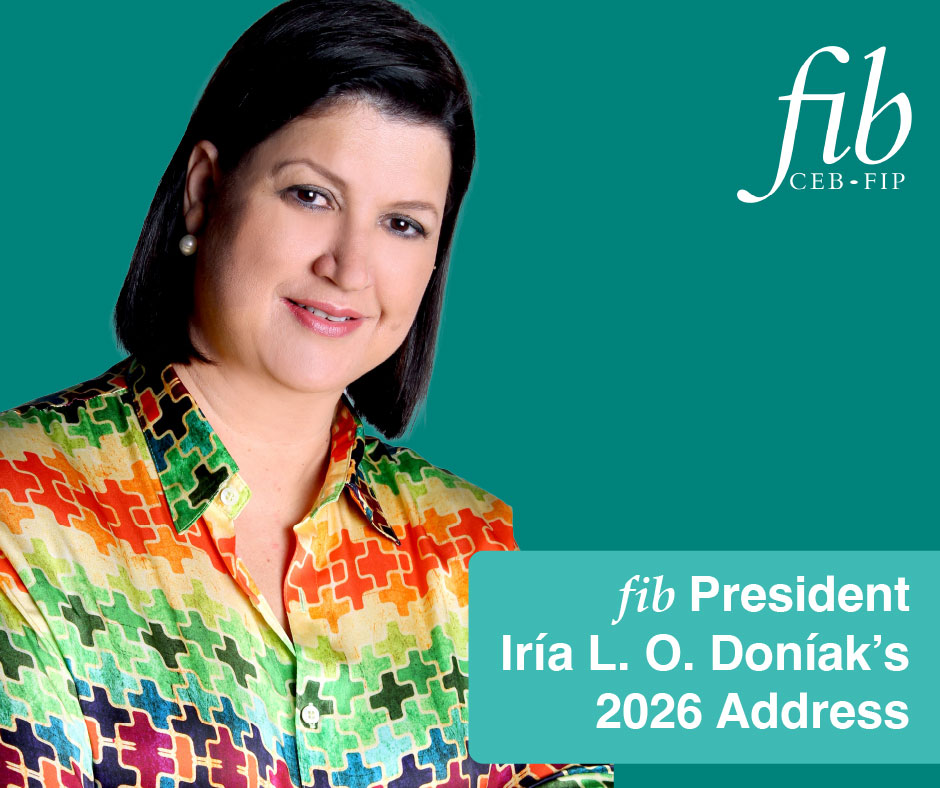
In a period defined by geopolitical uncertainty, climate urgency and rapid technological evolution, the responsibility of engineering institutions has become both broader and more strategic. Professional associations and federations are called upon not only to represent technical excellence, but also to provide direction, coherence and leadership in shaping a more resilient and sustainable built environment.
Concrete engineering lies at the heart of this responsibility. As the most widely used construction material globally, concrete plays a decisive role in addressing key challenges related to decarbonisation, structural safety and resource efficiency. Recent disruptions to global supply chains and increasing regulatory and societal expectations have reinforced the need for engineering solutions that are robust, adaptable and environmentally responsible.
In this context, the evolution of structural engineering practice is essential. The integration of conceptual design with performance-based design enables engineers to move beyond prescriptive solutions, fostering innovation while maintaining safety, durability and resilience. Such approaches allow sustainability considerations—particularly carbon reduction and lifecycle performance—to be embedded from the earliest stages of project development.
Decarbonisation remains a central priority. Significant progress has been made through the development of low-carbon cements, alternative binders, optimised structural systems and durability-driven design strategies. At the same time, the principles of the circular economy are increasingly influencing how concrete structures are designed, constructed, maintained and, ultimately, reused or recycled. Material efficiency, extended service life and lifecycle optimisation are no longer optional; they are fundamental components of responsible engineering.
Technological advances are accelerating this transition. Digitalisation, artificial intelligence, and data-driven tools are transforming how engineers conceive, analyse, and manage concrete structures throughout their entire lifecycle. These technologies enable better-informed decisions, support holistic sustainability assessments and enhance resilience in the face of uncertainty. Their effective adoption, however, depends on knowledge sharing, training, and active engagement across the profession.
This is where the fib plays a pivotal role. Developing guidance, facilitating collaboration between academia and industry, and creating platforms help translate innovation into practice. Equally important is member engagement. Active participation in initiatives related to sustainability, digital transformation, and artificial intelligence is essential to ensure the profession continues to evolve and respond credibly to global challenges.
The fib provides a trusted forum where members engage in constructive dialogue in a collaborative, respectful environment, fostering high technical standards.
As we reflect on the progress achieved in 2025, it is clear that meaningful advances have been made not only in decarbonisation strategies, digital tools and forward-looking design approaches, but also in the governance, management and strategic organisation of our institution. These improvements have strengthened our capacity to serve our members, engage more effectively with stakeholders, and contribute to the broader societal agenda.
Significant challenges—and equally significant opportunities—lie ahead in 2026. Addressing them will require collective effort, open collaboration and a shared commitment to innovation and responsibility. By working together and embracing both technical excellence and strategic vision, our institutions and their members can continue to shape a future in which concrete engineering contributes decisively to resilient infrastructure, sustainable development, and societal well-being.
Iria Lícia Oliva Doniak
fib President